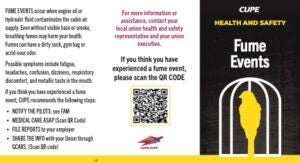
Click here to review the fact sheet from CUPE
Message from Your Health and Safety Committee
Recently, we have had many suspected fume events reported across the A330’s, when previously it had seemed to mostly be plaguing our A321 LR fleet and many are wondering why. We would like to clarify that the Pratt and Whitney engine issues/recalls were due to other reasons than fume events. Fume events can occur on all airplane types that pressurize the aircraft using bleed air from the engines.
We would like to take this time to highlight the steps to follow for a fume event, and hope this memo provides you with the guidance you need to navigate these situations.
What Are Fume Events?
Fume events involve the presence of smoke, vapor, or chemical odors in the cabin or cockpit, potentially stemming from engine bleed air systems or other onboard systems. Exposure to these contaminants can lead to symptoms such as dizziness, headaches, respiratory irritation, or, in some cases, more severe health effects.
Definitions:
Fumes: A mix of fine particles or gases, often resulting from the heating or breakdown of substances like oils or hydraulic fluids. Fumes may cause irritation or discomfort and require prompt assessment.
Smoke: A visible aerosol produced by overheating or incomplete combustion of materials, often accompanied by a distinct odor. Smoke may indicate a mechanical or electrical issue.
Possible sources of fumes:
- Engine oil leaks or spills
- Hydraulic fluid leaks
- Fuel vapors
- De-icing/anti-icing fluids
- Electrical faults or compressor wash residues
- Recirculation fan failuresContaminants in the ventilation air supply:
- Hydraulic Fluid Fumes: Sharp, acrid odors from leaks entering ventilation systems.
- Engine Oil Fumes: Often described as “dirty socks,” typically occurring during climb or descent due to overfilled oil reservoirs or leaks.
Immediate Actions During a Fume Event:
- Identify the source and describe the type and intensity of the fumes.(Referto Safety Bulletin 176)
- Notify the FCM and communicate using the”Four S’s”:
1. Source: Where is it coming from (e.g. vents, cabin item)?
2. Smell: How does it smell? What’s the intensity?
3. Site: Where in the cabin is it noticeable?
4. Symptoms: Are there any reported discomforts or illnesses? - Document the Incident : Make an entry in the CLG Complete a Safety Report (Specific details are crucial to the investigation- Note when the smell was noticed (e.g., descent, cruising), weather conditions, if any de-icing was performed, and pax reactionsIf symptoms occur, complete an Injury Declaration Report
*** Important: A CLG entry triggers an immediate investigation prior to the return of the flight. Do not wait until the return leg to complete an entry.
What to do if exposed to fumes:
- Seek medical attention if symptoms present themselves (via Medlink, paramedics, or MedAire)
- Follow instructions of medical personnel (ie: Administer oxygen, or other first aid protocols for symptoms such as dizziness or nausea)
- Monitor symptoms closely for at least 48 hours after exposure and report any changes to your medical practitioner.**Bring the relevant Safety Data Sheets (SDS) available on Mundo (under Cabin Standards/Safety Data Sheets), or on the FD iPad. These sheets contain 24-hour emergency contact information, chemical and hazard identification, and first-aid measures to assist healthcare professionals
**Important:
Blood tests for certain chemical exposures are often inconclusive or negative unless done at specialized clinics within a short timeframe (within 24 hours). Medical professionals can assess your condition based on your reported work environment, symptoms, and potential exposure history to determine appropriate care.
NOTE: During engine run-ups or decontamination procedures, we strongly recommend leaving the aircraft during the process.
Your Health and Safety Committee has:
- Collaborated with the company on a joint action plan involving maintenance, pilots, and cabin crew health and safety committees, ensuring a comprehensive response with input from all departments.
- Requested that training and awareness be provided to all CC, including:
- Adding a fumes module to annual training (ongoing)
- Including a section in the FAM on fumes (SAF BULLETIN 176) (done).
- Participated in Implementing a maintenance program specifically for fumes (partially done).
- Providing fume-specific PPE for suspected fume events (in progress).
- Integrating air quality sensors into the ventilation system to monitor for hazardous fumes (status unknown)
- Formally requested the grounding of specific affected aircraft to prioritize your health and safety.
- Initiated requests for joint investigations with the company to ensure crew safety
- Contacted crew members reporting active or suspected fume events as soon as the committee is made aware, to address immediate concerns, provide guidance and support, and ensure appropriate actions are respected.
Your Voice Matters
Every reported fume event is treated with the utmost seriousness. It is through your vigilance in reporting these events that we can continue to advocate a safer workplace for everyone.
Your Workplace Health and Safety Committee is here to support you. We are actively working to address fume events and ensure that your voice is heard. Your input is essential and what drives change.
The employer has sent out a communication earlier today. We trust them to continue in the future to clearly explain the actions they took and will take to address and correct those issues and share the findings from investigations conducted once available.
Remember: You have the Right to Know, the Right to Participate, and the Right to Refuse unsafe work.
- Right to Know: Access information about potential risks, such as chemical exposure and corrective actions.
- Right to Participate: Report fume events, providing input in investigations, and share observations to improve safety measures.
- Right to Refuse: If a fume event poses an immediate danger (e.g., strong odors causing dizziness or visible smoke), you have the right to refuse unsafe work until the issue is resolved.
Your Workplace Health and Safety Committee utilizes your input to refine meaningful safety improvements for all.
For further reading, please consult the CUPE Fumes fact sheet attached. Please don’t hesitate to reach out to us with any questions or concerns.
Contact: HS@atcomponent.com